Software Engineering: A Modern Approach
1 Shape Up: A Possible Alternative to Scrum?
1.1 Introduction
Shape Up is a software development method proposed by 37signals, the company behind the Basecamp project management tool. The method is described in an open-access book written by Ryan Singer.
1.2 Main Concepts
To introduce Shape Up, we will use analogies with other agile methods, especially Scrum. If you want to learn more about agile methods, see Chapter 2 of the book.
Development in Shape Up has three main stages:
First, there is an up-front design phase called shaping. This phase is simpler than in Waterfall (that is, it is not a big design up front, also known as BDUF). Instead, the idea is that every software project needs some high-level coordination to define and minimally specify the features to be built, establish boundaries, and assess risks and benefits.
After shaping, the actual sprint begins, and these sprints are called cycles. The cycles are longer than Scrum sprints, normally lasting six weeks. According to the author, six weeks is enough time to implement something meaningful without imposing excessive pressure on the team.
At the end of a cycle, there is a two-week cool-down period. Developers use this time to catch their breath and perform tasks such as fixing bugs, refactoring, paying down technical debt, studying new technologies, and building prototypes.
Moreover, teams are smaller than Scrum teams: usually one UI designer and at most two developers.
1.3 Shaping Phase
Shaping is the main phase of the method. It aims to find a middle ground between a detailed plan (as in Waterfall) and a vague, high-level plan (as sometimes happens in Scrum).
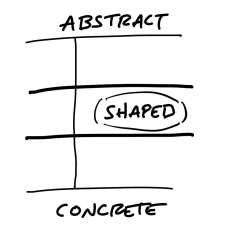
The book suggests that senior developers and managers should work on the shaping phase, which can occur in parallel with cycles and cool-down periods.
The output of shaping is a pitch, a simplified document proposing a new feature. It should describe:
- The problem the feature aims to solve.
- The expected implementation time, called appetite
(e.g., two-week or six-week features).
- A high-level description of the proposed solution, often using
sketches of screens or pages.
- Limitations and clarifications, referred to as no-go’s (acceptable limitations) and rabbit holes (potential implementation traps).
Pitches go to the bet table, where decision-makers choose which ones will be implemented in the next cycle. The decision happens asynchronously, followed by a short synchronous meeting. At 37signals, the CEO, CTO, a senior developer, and a product strategist participate in this meeting.
Therefore, there is no global backlog in Shape Up. However, each decision-maker may keep a personal backlog of pitches to propose at future bet tables.
Shape Up also emphasizes fixed time, variable scope
; that is
cycles last six weeks, but teams can adapt the scope of what will
actually be implemented.
1.4 Conclusion
Shape Up differs from Scrum in several ways:
- There is a dedicated shaping phase.
- There are no mandatory daily meetings, reviews, or
retrospectives.
- There are no artifacts like backlogs or Scrum/Kanban boards.
- Teams are small (one designer and one or two developers).
- There are no roles such as Scrum Master or Product Owner.
- Teams do not choose pitches; they receive them already shaped.
- Teams can adapt a pitch’s scope to fit the cycle duration.
- Cycles are longer than Scrum sprints and followed by a cool-down period.
Exercises
What is the difference between Shape Up’s shaping phase and Scrum’s sprint planning?
What happens when a team does not finish a pitch within a cycle? (To answer, see Chapter 8 of Shape Up’s book, titled
The circuit breaker
)What characteristic makes Shape Up suitable for remote teams?
In XP, what is the name of the practice similar to the cool-down period?
Propose a pitch: (a) Briefly describe it. (b) Identify a potential rabbit hole.
Check out the other articles on our site.